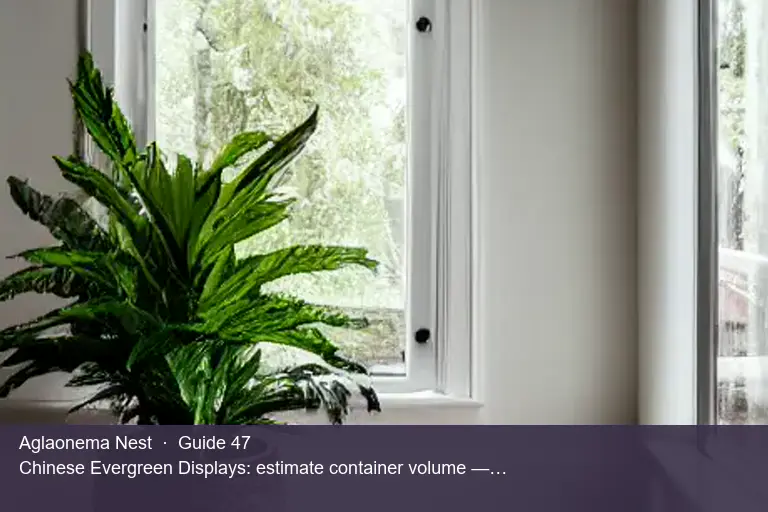
Chinese Evergreen Displays: estimate container volume — decision tree for a short care session; setup in small spaces
### Chinese Evergreen Displays: Estimate Container Volume for Small-Space Plans
Evergreen displays have become an essential feature for many indoor spaces, from offices to homes. However, choosing the right size for your evergreen display can be a daunting task. This article will guide you through the process of estimating container volume for Chinese evergreen displays, including a decision tree for a short care session. As a small-space planner, this advice is designed to help you create a functional and attractive display without overcrowding your space.
#### Step 1: Assess the Purpose of Your Evergreen Display Before estimating container volume, first determine the purpose of your evergreen display. Is it a large display for a large room? Or is it a smaller display for a smaller space? The purpose will guide the size calculation.
#### Step 2: Calculate the Total Number of Evergreen Plants To start, count the number of evergreen plants in your display. This is the number of plants you will be using for the display.
#### Step 3: Determine the Distance from the Center to the Edge Next, measure the distance from the center of the display to the edge. This will give you a reference point for the display's overall size.
#### Step 4: Estimate the Height of Each Plant Now, estimate the height of each plant. This can be done using a ruler or measuring tape. If you have a measuring tape, measure the height of each plant. If you have a ruler, measure the length from the center of the display to the edge and divide by the number of plants.
#### Step 5: Estimate the Volume of Each Plant Finally, estimate the volume of each plant using a measuring tool, such as a glass or a measuring cup. The volume of each plant should be the same for all plants in the display. If the plant is a cylinder, multiply the height by the diameter. If the plant is a sphere, multiply the volume by the radius.
#### Step 6: Calculate the Total Volume of the Display Now that you have the volume of each plant and the total number of plants, you can calculate the total volume of the display. To do this, multiply the total number of plants by the volume of each plant.
#### Step 7: Set the Container Size Finally, set the container size based on the total volume of the display. This will help you determine the size of the container you will need to display your evergreen display.
#### Step 8: Make a Decision After setting the container size, make a decision based on the purpose of your display. Is it a large display for a large room? Or is it a smaller display for a smaller space? This decision will help you choose the right size for your evergreen display.
#### Step 9: Practice and Test Before making your final decision, practice and test your estimate. Use a measuring tool to estimate the volume of each plant and the total number of plants. Test your estimate with different sizes of containers to ensure accuracy.
#### Step 10: Create a Display Finally, create your display by placing the evergreen plants in the appropriate containers. Make sure to maintain a balance between the height of the plants and the container size.
#### Decision Tree for a Short Care Session
As a small-space planner, the decision tree for a short care session can be summarized as follows:
- Assess the purpose of your evergreen display
- Calculate the total number of evergreen plants
- Determine the distance from the center to the edge
- Estimate the height of each plant
- Estimate the volume of each plant
- Calculate the total volume of the display
- Set the container size based on the total volume of the display
- Make a decision
- Practice and test your estimate
- Create your display
#### Conclusion
By following this process, you can easily estimate the container volume for your Chinese evergreen display. This method is designed to help you create a functional and attractive display without overcrowding your space. Remember to practice and test your estimate regularly to ensure accuracy.