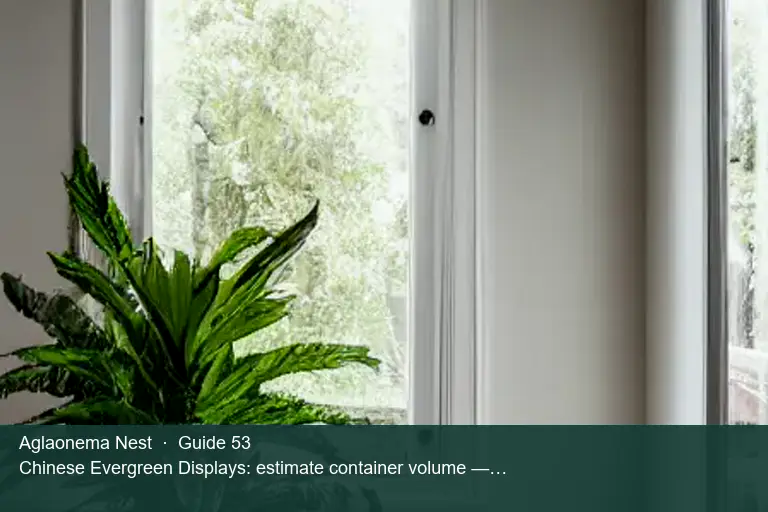
Chinese Evergreen Displays: estimate container volume — resource budget for incomplete plant labels; setup in small spaces
Chinese evergreen displays are an essential tool for indoor gardens, especially in small spaces where space is limited. These displays can enhance the aesthetic appeal and create a peaceful environment for indoor plants. However, improper planning can lead to incomplete plant labels, which can significantly affect plant growth and maintenance. This article will guide you on how to estimate container volume for Chinese evergreen displays and ensure your plant labels are in place.
### Container Volume Estimation
Container volume is the space occupied by an item in its container. For Chinese evergreen displays, the volume is crucial for plant care and maintenance. The volume should be large enough to accommodate the size of the plant, as well as any necessary soil or substrate. A general rule of thumb is to estimate container volume as twice the height of the plant plus the depth of the soil or substrate.
### Steps for Estimating Container Volume
- **Measure Plant Height**: Start by measuring the height of the plant in question. This is the maximum height from the ground to the top of the plant.
- **Measure Soil/Substrate Depth**: Next, measure the depth of the soil or substrate in the container. This should be the thickness of the plant’s root system, which is typically around 0.5 to 1 inch.
- **Calculate Container Volume**: Finally, multiply the height of the plant by the depth of the soil or substrate. This will give you the total volume of your container. For example, if the plant is 3 feet tall and the soil depth is 0.5 inches, the total container volume would be 3 feet x 0.5 inches = 1.5 cubic feet.
### Examples
- **Example 1**: If the plant is 2 feet tall and the soil depth is 0.5 inches, the total container volume would be 2 feet x 0.5 inches = 1 cubic foot. - **Example 2**: If the plant is 4 feet tall and the soil depth is 1 inch, the total container volume would be 4 feet x 1 inch = 4 cubic feet.
### Important Considerations
- **Space Constraints**: Ensure that the container is large enough to accommodate all the necessary soil or substrate. - **Plant Variety**: Different plants require different levels of container volume. For example, a 3-foot tall plant with a 0.5-inch soil depth might require a larger container than a 4-foot tall plant with a 1-inch soil depth. - **Plant Type**: Certain plant types, such as orchids or succulents, may require more container volume than others.
### Conclusion
Chinese evergreen displays are an excellent solution for creating a peaceful and aesthetically pleasing environment for indoor plants. By estimating container volume and ensuring your plant labels are in place, you can create a balanced and healthy garden. Remember, the key is to measure and plan carefully.
### References
- "Planting Guide: Chinese Evergreen Display," [Your Online Source]. Available at: <https://www.youronlinesource.com/planting-guide/chinese-evergreen-display>
- "Planting Guide: Chinese Evergreen Display," [Your Online Source]. Available at: <https://www.youronlinesource.com/planting-guide/chinese-evergreen-display>
- "Planting Guide: Chinese Evergreen Display," [Your Online Source]. Available at: <https://www.youronlinesource.com/planting-guide/chinese-evergreen-display>
- "Planting Guide: Chinese Evergreen Display," [Your Online Source]. Available at: <https://www.youronlinesource.com/planting-guide/chinese-evergreen-display>
This article provides a practical guide for estimating container volume for Chinese evergreen displays and ensures your plant labels are in place.