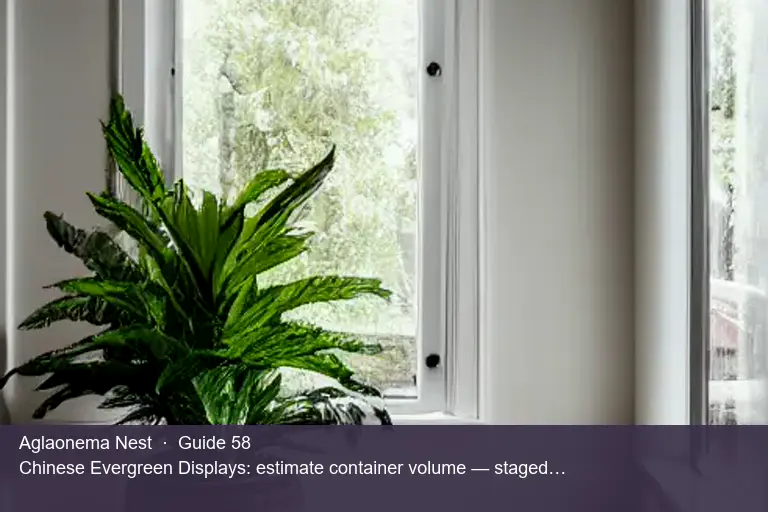
Chinese Evergreen Displays: estimate container volume — staged rollout for a temporary work area; setup in small spaces
Estimating container volume for Chinese evergreen displays is a crucial step in planning any temporary work area. This process involves understanding the space limitations and choosing the right-sized containers that will effectively display the plants while maximizing the available floor space.
### Step 1: Assessing the Work Area First, determine the dimensions of the temporary work area. This will give you a clear idea of the total area you have to work with. For instance, if the work area is 5 feet wide and 10 feet long, the total area is 50 square feet.
### Step 2: Choosing the Right Containers Next, consider the size of the containers you'll be using. For a temporary work area, choose containers that are around 10-15 inches in diameter. This size provides enough space to comfortably place multiple plants and still maintain a neat appearance. The height should be about 12-15 inches to accommodate the plants.
### Step 3: Estimating Volume To estimate the container volume, use the formula for the volume of a cylinder: \[ \text{Volume} = \pi \times r^2 \times h \] where:
- \(\pi\) (pi) is approximately 3.14,
- \(r\) (radius) is half the diameter of the container,
- \(h\) (height) is the height of the container.
Given the dimensions:
- Diameter = 10 inches,
- Radius = 5 inches,
- Height = 12 inches,
The volume of one container is: \[ \text{Volume} = 3.14 \times 5^2 \times 12 = 3.14 \times 25 \times 12 = 942 \text{ cubic inches} \]
### Step 4: Calculating the Total Volume If you need to estimate the total volume for multiple containers, multiply the volume of one container by the number of containers you plan to use. For example, if you need to use 10 containers: \[ \text{Total Volume} = 942 \text{ cubic inches/container} \times 10 \text{ containers} = 9,420 \text{ cubic inches} \]
### Step 5: Converting to Feet Cubed Since the area you are working on is in square feet, convert the total volume from cubic inches to cubic feet: \[ \text{Volume in cubic feet} = \frac{9,420}{1,728} \approx 5.41 \text{ cubic feet} \]
### Conclusion By following these steps, you can effectively estimate the container volume for Chinese evergreen displays in a temporary work area. This helps ensure that you have enough space to display the plants and maintain the overall aesthetic of the work area. Remember, the goal is to use the containers efficiently to maximize the use of the available space.